

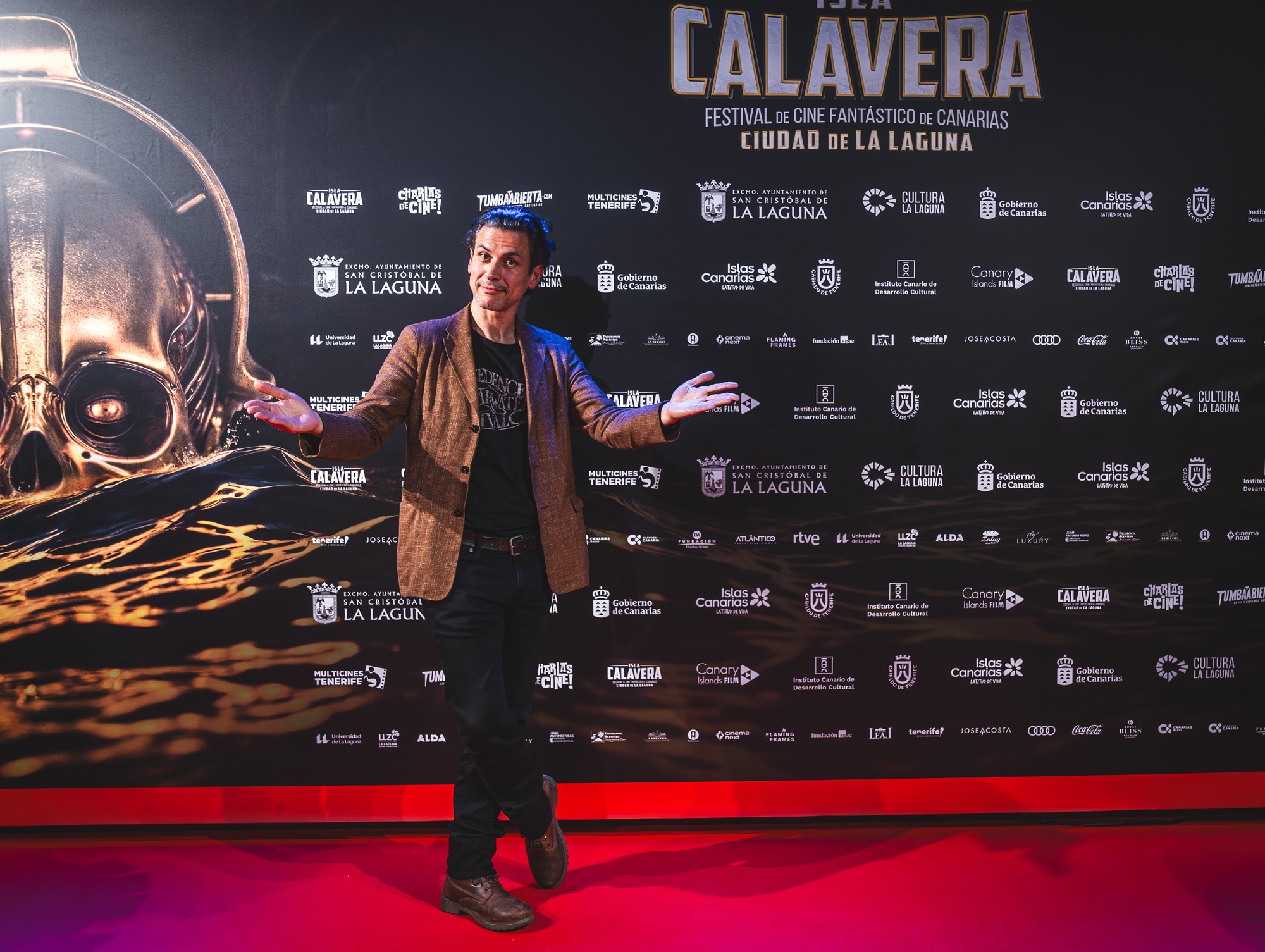
Rodrigo Cortés Giráldez, better known as Rodrigo Cortés, was born in Orense on May 31, 1973. At the age of 16, and linked to Salamanca where he grew up moving with his family since he was two years old, he made his first audiovisual work there. El desmedido y espantoso caso del victimario de Salamanca (1989) is the extravagant title of his debut short film, shot in super 8 at the tender age of 16. Cortés graduated in art from the University of Salamanca, the oldest in Spain. His next short film is Seven scenes in the life of an insect (1994), a tribute to The Metamorphosisthe legendary novel by Franz Kafka, which he also shot in 8 mm. These two works provide the filmmaker with first-hand knowledge of the entire cinematographic process. In those years, Cortes is already fully committed to professional filmmaking as "the most complete and fullest form of storytelling" in his own words.
1998 is an important year for the filmmaker. It was the year he premiered the short film Yulhis passport of introduction to the film community, which he shot in 35 mm. Rodrigo Cortés wins more than 20 awards at different Spanish festivals. 15 days (2000) is a 29-minute short film, a mockumentary that follows Castor Vicente Zamacois, a kind of "bulimic" of teleshopping, who after getting fed up with shopping, manages to return everything he buys compulsively, within the legal period of 15 days, within which he can claim back the money paid. It is filmed in a prodigious combination of 8 mm, 16 mm and digital video, among other formats. It obtained around 50 awards and a nomination to the Goya awards.
With all this technical, narrative and experimental background, Rodrigo Cortés takes the leap to feature film with Contestant (Spain, 2007). Starring Leonardo Sbaraglia, it tells the story of a professor of economic history who wins a quiz contest in his discipline, winning 3 million euros. The financial and banking system, as well as those who do nothing but create needs for him, integrate him into a loop of great paradoxes of the capitalist and consumerist system, difficult to escape.
It won the Critics Award at the 2007 Malaga Film Festival and a nomination for the 2008 Goya Awards.
He made the leap to the international scene with Buried (BuriedSpain, Spain, France, UK, USA, 2010), a lesson in how 93 minutes in the suffocating scenario of a wooden box, underground, can be enough to build an effective and sober narrative exercise, full of rhythm. Paul Conroy (Ryan Reynolds), an American truck driver working in Iraq, is found buried with a Zippo lighter and a Blackberry with a low battery. Conroy tries to figure out what the hell happened and why he's there.
For his next film, Red Lights (Red Lights, Spain-USA, 2012), he managed to summon no less than Robert De Niro, Sigourney Weaver and Cillian Murphy. The film narrates the confrontation between a parapsychologist and a reputed clairvoyant whom she tries to discredit. In 2018, Cortés releases his film Blackwood (Down a Dark Hall, USA-Spain), a horror film in which a student confronts her teacher, endowed with chilling powers, at a gloomy boarding school. It stars Anna Sophia Robb and Uma Thurman. It is based on the novel by Louis Duncan.
Always taking on challenges, Cortés rolls Love in its place (Love Gets A RoomSpain-UK, 2021). It tells in a musical key how a group of Jews in the Warsaw Ghetto during the Second World War perform a musical theater play. With Escape (Spain, 2024), the all-terrain filmmaker navigates between macabre comedy, drama, social denunciation and surrealism, symbolism and metaphor, based loosely on the novel by journalist and writer Enrique Rubio. The film is presented by none other than filmmaker Martin Scorsese.
Rodrigo Cortés has also directed The Jokean episode of the third stage of the television series Historias para no dormir (Spain, Prime video-RTVE, 2021 to present).